Research stay in Graz, Austria: Between Stairs, Screens, and Scholarly Exchange
- Saemi Nadine Jung
- Dec 23, 2025
- 5 min read

Updated: Dec 24, 2025
A research stay abroad often sounds glamorous—new places, new people, new ideas—especially when the destination is somewhere in Europe (speaking as a doctoral researcher based in Vancouver, Canada). And while my time in Austria certainly delivered on inspiration and intellectual excitement, it also reminded me that meaningful experiences rarely come without a few hurdles along the way.
Jet Lag, Time Zones, and Immediate Commitments.
The challenges began almost immediately. With little time to adjust to the time difference, severe jet lag set in, leaving me lightheaded and dealing with an upset stomach. By the third day, I was so sick that I could barely walk straight.
It became even more challenging by an immediate commitment: just one day after my arrival, I was scheduled to join a post-film discussion panel. The panel was part of thinking about Caring Technologies, Caring Democracies, a cinema film series organized by the Center for Interdisciplinary Research on Aging and Care (CIRAC).
Opening the Film Series as a Panelist: Caring Technologies, Caring Democracies
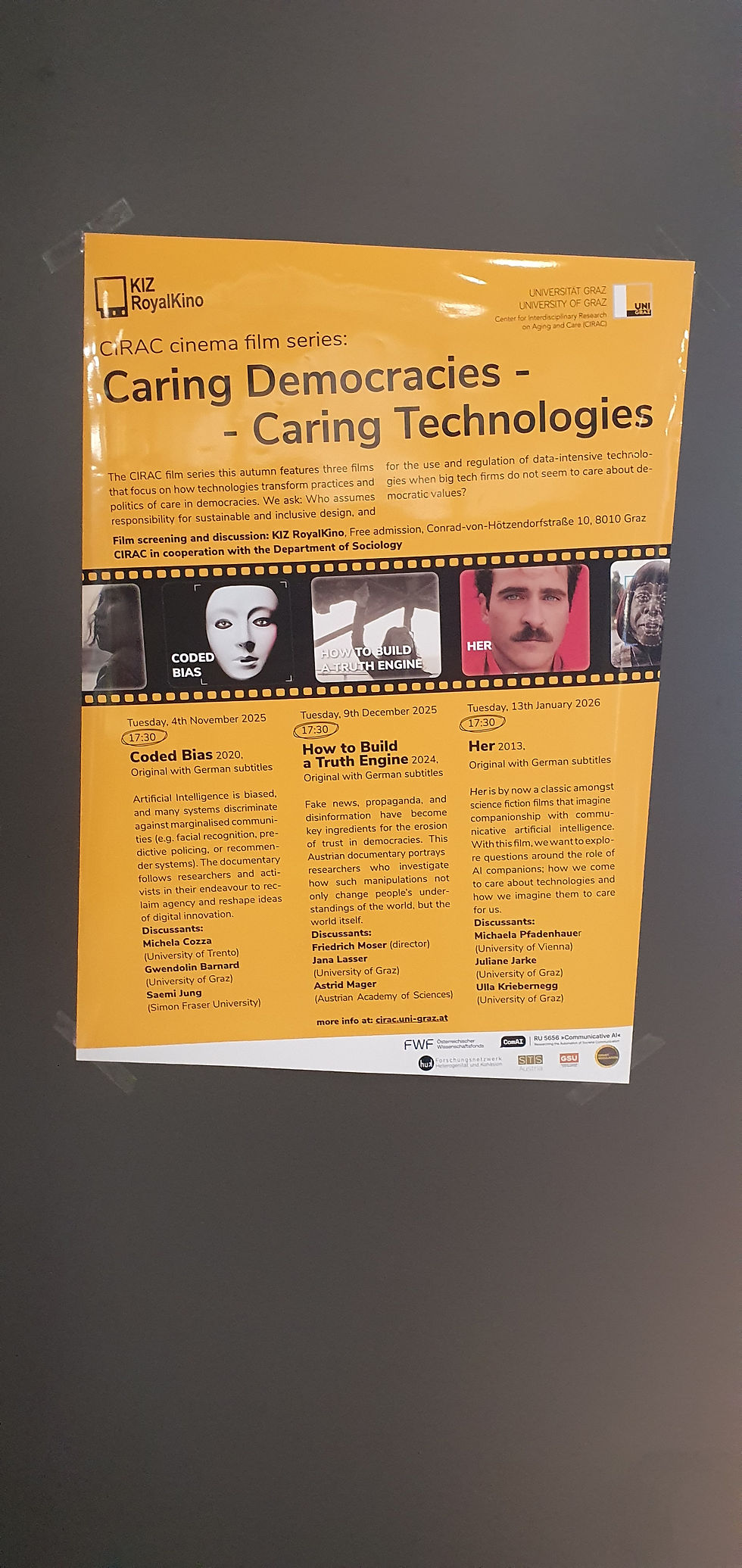
The last few minutes were unfortunately uncaptured, but for those who would like to watch the discussion, here it is.
This was the first film in the series, thoughtfully prepared by the organizers, Dr. Juliane Jarke and Dr. Ulla Kriebernegg at the University of Graz. Curated with great care, the opening event ended on a high note. I especially enjoyed rewatching the documentary Coded Bias, which I had first seen during my time in London (2020–2021).
The conversations that followed were rich and memorable, and I’m still carrying many of those reflections with me. The audience was incredibly engaged—asking thoughtful questions and actively contributing to the discussion. I left the event with my mind full of ideas, feeling connected to the audience across continents.
That sense of intellectual energy, however, was quickly tested the next morning by another challenge: a three-hour workshop from 9:00 a.m. to 12:00 p.m., which left me completely exhausted.


When Preparation Meets Physical Limits
Days and nights blurred together, concentration became a struggle, and before long, exhaustion turned into unfortunate sickness. This was deeply frustrating, as I had been eagerly preparing for this research stay—along with the doctoral academy in Graz—for several months. It forced me to slow down far more than I had anticipated and I had to be okay with it.
Adding to the physical strain was the building itself—charming, historic, and entirely without an elevator.

Navigating four floors multiple times a day may sound trivial, but with fatigue lingering, health not fully recovered, and a pre-existing injury from the past, the constant ascent and descent took a noticeable toll. It took me about 20 minutes to haul my 20-kilogram suitcase upto my accommodation on the first day, which put a bit too much pressure on my knees. By the end of each day, my knees felt weak, a reminder that even small physical challenges can feel overwhelming when one’s energy is already depleted.
Still, there was something quietly grounding about those staircases: each climb marking another conversation, another meeting, another opportunity waiting at the top. Every trip up the stairs marked progress. Reaching the top meant engaging with people, ideas, and moments that made the effort worthwhile. Over time, the repetition turned into a calming routine. Instead of feeling purely draining, the climbs became moments of reflection and mental pause. It almost became meditative.


Despite challenges—or perhaps partly because of them—the intellectual rewards of the stay were immense. The discussions I had with colleagues were truly scintillating.
Scintillating Research Discussions and Intellectual Renewal
Especially the BANDAS talk Business Analytics and Data Science-Center - Universität Graz, where Dr. Lukasz Duelba and I were invited to share our research, ideas were exchanged generously, marked by thoughtful back-and-forth questions and engaged discussion. Conversations flowed easily, perspectives shifted, and insights emerged in ways that only happen when scholars from different academic backgrounds and cultures come together. Even brief, informal exchanges often sparked moments of clarity or offered new ways of framing familiar problems. For my talk, Tracing Methods, Making Meaning: Research Across Technology and Society, the following is the abstract.
Abstract of the talk:
How do research methods shape what we come to know about technology and society? This talk brings together studies that question power dynamics—who benefits, who is included, and who is excluded—by exploring human experiences across different domains, from the lives of female immigrant keypunch operators in early computing history to a multi-sited ethnography of EdTech in contemporary classrooms. Through these projects, I reflect on how methodological choices—archival, ethnographic, and critical case study—shape our understanding of people’s interactions with sociotechnical systems. By tracing connections between these distinct studies, I show how methods are not just tools for inquiry but frameworks that make certain forms of knowledge visible while obscuring others. The talk invites discussion on what it means to conduct human-centered research in a technological world.

Another key talk that I had prepared during my research stay in Graz was titled "Visibility and Power: Research across Tech and Society." In this talk, I discussed three key projects—two from the Digital Democracies Institute (Keypunch operating as Mind-numbing Refuge for Korean Canadian Immigrant Women with Dr. Wendy Hui Kyong Chun and the BRIDGE consortium project) and one from my own research on the AI-textbook case study—showcasing methods and approaches for more human-centered research.
The full lecture video is available here:
Again, the audience was amazing. I loved interacting with them, getting questions, clarifying them with answers, and thinking together to talk about what it means to do human-centered research. Research that benefits people. Research that would make differences in people's lives.
Conversations Across Continents: Reconnecting with Fellow Scholars
(Re)connecting with both new and familiar researchers was another highlight of the experience. Engaging with people who approach similar questions from different angles—whether through unique tools, ideas, or perspectives—was deeply inspiring. Learning about the work of fellow researchers was fascinating in its own right. These interactions ignited a sense of curiosity and motivation that helped carry me through even the most exhausting days and most importantly, my own research work. They helped me reorient myself and gave me a sense of freshness. Inspiration doesn’t always come when conditions are perfect; often, it emerges precisely when you’re pushed beyond your comfort zone.
Looking back, the research stay in Austria was a lesson in contrast. Physical fatigue stood alongside intellectual stimulation. Challenges coexisted with intellectual stimulation, and they were also balanced by creativity and inspiration.
While the jet lag, illness, and endless flights of stairs (a particular challenge for a Vancouverite) presented their difficulties, they never overshadowed the true value of the experience. If anything, they deepened my appreciation for the moments of connection and insight that made the trip so rewarding. I am also incredibly grateful for the opportunity to stay and engage with researchers and scholars at the University of Graz for an extended period of time.
In the end, I returned not just with notes and ideas, but with a renewed enthusiasm and inspiration for collaboration and research. The stay was demanding and occasionally uncomfortable due to health issues—but it was also deeply inspiring. It's often through this very combination of challenge and inspiration that the most meaningful growth takes place.
Keywords: #Research, #Social Science Research, #University of Graz, #Researchstay #Researchaboad



Graz seems like a fascinating city for research stays, blending history with modern scholarly life. The focus on academic exchange is impressive. For professionals seeking to expand their expertise, an Executive course in Vienna, Austria can complement this experience, offering advanced skills and networking opportunities in a vibrant academic environment.